But the Parents for the Children

2 Corinthians 12:14  Behold, the third time I am ready to come to you; and I will not be burdensome to you: for I seek not yours, but you: for the children ought not to lay up for the parents, but the parents for the children.

As with any verse in Scripture, this one teaches many things. There is the direct application of what Paul was telling the Corinthians concerning his ministry to them, but what is striking me right now is one of the secondary truths Paul states here: that of laying up for the children.

While many Christians are busy claiming Matthew 6 and “taking no thought” of life, food, drink, and clothing, what are they doing to “lay up” for their children?  And what of providing for their own house?

1 Timothy 5:8  But if any provide not for his own, and specially for those of his own house, he hath denied the faith, and is worse than an infidel.

As believers in this Church Age, we are to consider Paul first (2Ti 2:7), so let us focus on what Paul tells us to do for a moment.

There is an effort right now that is indicative of the general spirit of the times in the United States. We are poised to elect the most Marxist candidate ever to the presidency, in so doing transferring more responsibility off of the individual to the State. The nation is on the verge of demanding the nationalization of the health care services industry. These are certainly not “providing for his own.” We demand from our government new handouts in the forms of economic stimulus checks and home finance bailouts, and our politicians happily oblige us by borrowing more money from our children and grandchildren — the children laying up for the parents.

While we (and I speak to those of us who are Bible believers) may not have a strong influence on our government, we can certainly do more in our own lives to take ownership of our God-given responsibilities. Paul’s writings in Scripture are not suggestions, so let us take consideration of what we are doing and be sure to line up ourselves with Scripture:

  • Do you look to the government or other people for your basic provision, or do you do everything in your power to “provide for your own?”
  • Do you put your hopes in a ponsi scheme for retirement (Social Security) that requires your children and your children’s children to “lay up” for you, or do you make provision for your own welfare in the future?
  • Do you hope for the government to care for your health, or do you care for your own health?
  • If you have children, have you planned for their care in the event of your death? (Lay up for the children!)
  • Do you “lay up” for your children by ensuring they are learning strong character, independence, and honesty, or do you leave their training up to other people who are not even allowed to teach such matters?

We do not live in a world where doing everything above is easy or necessarily possible all of the time. However, the Bible does not leave us room for apathy on these things. In fact, Paul’s comments here would be regarded as heartless by today’s humanistic standards:

2 Thessalonians 3:10  For even when we were with you, this we commanded you, that if any would not work, neither should he eat.

When you go before Christ to give an accounting for your life as a child of God, are you going to have to answer for not abiding by the precepts?

Don’t misunderstand me — we have a responsibility to care for those among us who can not care for themselves. That’s not what I am talking about. I am talking about our Biblical duty to care for our selves and not force our children to lay up for us.

Living by the Truth is hard. These precepts are hard and go against the grain of so much modern teaching on the subject that even bringing these truths up can get you shunned by other Christians. But they are there nonetheless.

Are you doing everything you can to live by them?
Supreme Court Actually Reads Constitution

Well, I’m sure everybody who cares has heard by now that the Supreme Court has affirmed that an individual has the right to own guns, and that the individual right doesn’t have anything to do with military service.

So today we had a “duh” ruling. This is so obvious that one has to wonder when the four dissenting judges are going to be impeached by Congress for blatantly denying Constitutional rights.

What should worry people who care about the Constitution is that this was a 5-4 ruling. That means that there was actually a “swing vote” over such an obvious and clear right protected by the Bill of Rights. That means that it would only take one Constitutionalist judge being replaced by a liberal to erase this obvious, clear right from existence.

I won’t bore people with more punditry — it’s all been said. I’m glad that the Supreme Court has affirmed an obvious fact, and struck down an obviously unconstitutional law. I’ll be happy about that and shut up now.

SwordSearcher Modules

Ever since SwordSearcher 4.0, there have been users sharing modules (Commentaries, Books, etc) that they have built for the software. There are quite a few of them floating around the net, so it’s high time I did something to help SwordSearcher Bible Software users find them in case there are items of interest in their study.

SSModules: Free Module Downloads for SwordSearcher Bible Software is currently in “beta.” It’s beta because there isn’t much listed there yet, but I’m working on it.  My goal is two-fold:

  1. Index many of the modules available from third parties.
  2. Upload my own “extra” modules that I have built but not added to SwordSearcher’s Deluxe study library for one reason or another.

Work will be ongoing. I don’t know how long it will be “in beta” (certainly not perpetual beta like a Google internet service), but it’s usable now, so have a visit if you’re a SwordSearcher user.  You may find something you like.

SwordSearcher 5.3 out the door

SwordSearcher Bible Software version 5.3 is finally released. Yay!

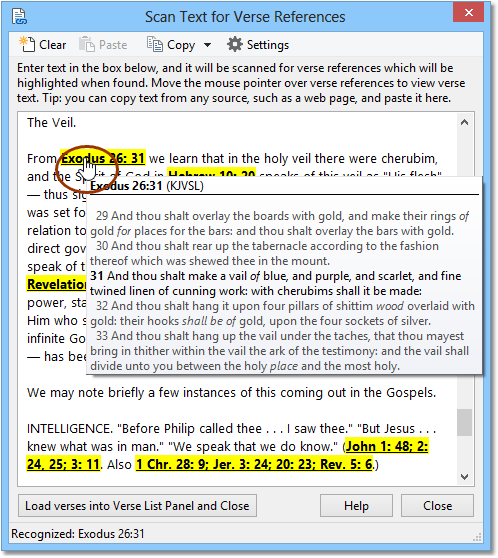
In looking over the revision history, I think this is one of the most significant updates since 5.0 — not because of new content, but just because of new code. The new user editor should really be useful for people writing their own personal notes in the software, and the new Scan Text for Verse References tool should be an all-around time saver for anyone who reads Bible study stuff on the web.

Here’s what it does:

SwordSearcher Scan Text for Verse References tool

In the above example, I copied in text from a web page using the Windows clipboard. Each reference is automatically highlighted by SwordSearcher, and I can hold the mouse pointer over a reference to read the Bible text as I read along in the article. Obviously, clicking the verse links performs actions such as moving the Bible panel to the passage or loading the references in a Verse List panel.

This even works with “old style” commentaries that use Roman numerals for chapter identifiers.

(Geek alert: the rest of this blog post is programmer stuff.)

In order to handle this automatic verse reference discovery, I built a custom parser that uses a combination of Regular Expressions and good ‘ol Delphi code. SwordSearcher can understand over 2,000 forms of Bible book names and abbreviations. Jan Goyvaerts’ program RegEx Buddy was an invaluable aid in developing the RegExes SwordSearcher uses internally — I highly recommend it if you have to build RegExes in your line of work.

Anyway, version 5.3 was a lot of fun to develop. Now I can switch gears for a little while and do some other work that’s been waiting for me…

College: Who needs it?

Most people don’t. Let me get this out of the way: there are many jobs that can only be done professionally after many years of careful supervised study. If you are going or went to college to do one of those types of jobs, this post isn’t about you.

This post is about me — and other people doing things that just don’t benefit from a college education.

I fully realize this is non-conformist thinking. Most people will dismiss what I’m saying as crackpot stuff. But let me tell you what I think is truly crazy: going into debt before you even get your life started. With college debt for even the most simple of degrees starting at $30,000, one has to ask who’s crazy — the people assuming that debt for the sake of a college degree or the people who decide to skip the debt and go to work?

First, some foundation: College is really expensive and people pay for it for a long, long time. It sounds obvious, but people don’t seem to really understand it, so read it, and let it sink in. Is it any wonder that our nation is getting deeper and deeper into debt? People are starting their life in the hole. One salient paragraph from the article linked above:

A 22-year old student graduating this year who consolidates their $40,000 loan at 6.125 percent will need to pay $243 a month…until they’re 52. By that time, they will have paid $47,494 in interest alone.

So, is this necessary? Rarely.

Let’s dispense right now with that myth that says College = More Money. Wrong. College may be necessary for certain, specific lines of work, but College does not cause increased earning over a lifetime although it correlates with it. (Sad aside: I bet half of the college graduates from last year couldn’t explain to you what the difference between causation and correlation actually is. Those are the same people who think big profits equal big profit margins and vote for candidates who promise to take on Big Oil. But I digress.)

Check this out: Five reasons to skip college. An excerpt:

In fact, there is plenty of evidence that what really matters is how smart you are, not where–or even if–you went to school. According to a number of studies, small differences in SAT scores, which you take before going to college, correlate with measurably higher incomes. And, according to a report from the National Bureau of Economic Research, the lifetime income of high-school dropouts is directly associated with their scores on a battery of intelligence tests.

Those correlations contradict the notion of a causal relationship between college degrees and increased earnings over a lifetime.

Let’s get on to another simple fact: College doesn’t teach you all that much. Another excerpt from the above linked article:

For, in truth, most professions–journalism, software engineering, sales, and trading stocks to name but a few–depend far more on “on-the-job” education than on classroom learning. Until relatively recently, lawyers, architects and pharmacists learned their trade through apprenticeship, not through higher education.

Let’s take software engineering, a subject I happen to know a bit about. I can say with absolute, unequivocal certainty that there is nothing about computer science college can teach you that you can not learn on your own. I know this because I: 1. Spent the summer between my last year of high school and first year of college learning all sorts of computer science-y things on my own, and 2. Spent the first year of my time in college bored out of my mind in my computer science classes. Every now and then I would wake from my stupor to help a fellow pupil or correct an error on the dry erase board.

What’s the difference between a computer programmer with a college degree and a computer programmer without one? The guy without the degree has a four year head-start on the guy with the degree.

But there’s more — colleges don’t even teach real programming skill in the first place. (Seriously — as a programmer, I find the notion of someone holding a computer science degree who has never used pointers a complete absurdity.)

My first undeniable truism of college:

Going to college to “learn” is like taking a one month vacation to Mexico for a taco. And putting it all on a credit card. With no job. Fact 1: Tacos taste better in Southern California. Fact 2: Tacos in Mexico may or may not be made out of what you expect a taco to be made out of. Fact 3: Any idiot can fly to Mexico for a taco: it takes a smart person to realize that money is better spent eating at an upscale Mexican restaurant in Southern California. Fact 4: Taking vacations when you don’t have a job or money just isn’t wise.

A big lie our culture has embraced is the notion that learning only occurs in institutions. We are all collectively taking a vacation from a job we don’t even have just to fly to a foreign country to eat a taco.

Lost? Okay: the guy who stays in his own country to eat a taco and has a job is the guy who reads books to learn instead of mortgaging his future for a college eduction with the same goal.

Going to college because one “loves to learn” is just crazy. I love to learn. I can spend $100 on books and learn more than a college student does in an entire semester — unless you count all that nonsense about “socialization” where one “socializes” with tons of other people who know just as little as they do about the real world and spend weekends chugging beer to prove it (or, if they’re a little more mentally developed, maybe they chug lattes). What’s more, I can actually live my life while I read the book. You know, like working. I suppose the guy who reads books does miss out on the “Psych 101” factor — that college thing were one semester of Psychology (even when you are majoring in computer science) suddenly makes the college student an expert in human behavior. I guess there are trade-offs.

Here’s my second truism of college: If you go to college and yet don’t know exactly how it will benefit you in your specific career, you are wasting time and money. Here’s a little-realized fact: College will still be there in another couple of years. If you haven’t decided what you need to learn yet, you should not be spending your money (or your parents’ money) — especially not debt — on college. So don’t go to college without a plan. If you can’t make a plan, then go do something real for a while first. (Hint: going to college is as far from real life as you can get.) This country is full of opportunity, and you don’t need to shell out tens of thousands of dollars to explore your options. And if you butt up against someone who says you’re nothing without a college degree — forget ’em. Move on. Make your own life.

Here’s a third truism: People who go into debt for tens of thousands of dollars and come out of college with a degree they will never use are not running on all thrusters. There exists no rational, justifiable reason to spend so much money on something that is not going to directly enhance your life in a tangible way.

You think saying most people don’t need college is crazy? I say going to college and only coming out with a piece of paper, warm and fuzzy feelings about “learning,” and over $30,000 in debt and no job is crazy.

The fact is, education has become a multi-headed monster our culture worships. Money and time is burned on the altar of institutionalized education, when real life — character, honesty, tenacity, hard work, and independence — is only learned through experience.

If you’re a college grad (and kudos to you for reading this far!), don’t be insulted. Take stock of your accomplishments in life. I think you’ll find that the gains you’ve achieved in your life are not due to time you spent in college, but what you did with your life. And if you haven’t got their yet? Don’t worry — it’s only four years.

PS: Before anyone says “what about heart surgeons,” please read the first sentence of this post before embarrassing yourself.